
Indian democracy is considered one of the wonders of the world. The fact that despite diverse languages, religions, castes and cultures, the nation is politically united under the umbrella of a single constitution is the greatest achievement of Indian politics.
1. Historical Background: Foundation (1947 – 1967)
Indian politics began with the dominance of the Congress . During this period, under the leadership of Pandit Jawaharlal Nehru, India strengthened the foundations of democracy.
- Constitution Creation: Dr. Under the leadership of Babasaheb Ambedkar, the world’s largest written constitution was adopted.
- Organizational Politics: During this period, the opposition parties were weak, but internal democracy was alive.
- Linguistic Reorganization: The division of states on linguistic lines in 1956 was a significant milestone in Indian politics.
2. Emergency and the politics of alliances (1967 – 1990)
The rise of Indira Gandhi changed the face of Indian politics. The centralization of power and the subsequent Emergency (1975-77) were a major assault on democracy, but it was also the first major opposition alliance to emerge in the form of the Janata Party.
- Regional Identity: During this period, regional parties like the Dravidian parties in Tamil Nadu, the Akali Dal in Punjab, and the Shiv Sena in Maharashtra became dominant.
- Mandal and Kamandal: In the 90s, two issues, ‘Mandal Commission’ (reservation) and ‘Ram Janmabhoomi’ (religious polarization), changed the direction of Indian politics forever.
3. The era of alliances and coalitions (1991 – 2014)
After the economic reforms of 1991, India ended the era of stable majorities and moved towards Coalition Politics .
- NDA vs UPA: Two major alliances, the NDA led by Atal Bihari Vajpayee and the UPA led by Manmohan Singh, ruled the country.
- Forced coalitions: Small regional parties played the role of kingmakers, which often limited the central government in making policy decisions.
4. Modi Wave and the Changing Political Culture (2014 – 2026)
After 2014, a single umbrella force emerged in Indian politics in the form of ‘Brand Modi’ and the BJP.
- Development and Nationalism: BJP won consecutive elections on the basis of ‘Sabka Saath, Sabka Vikas’ and strong nationalism.
- The impact of social media: Elections are now fought more on WhatsApp and Twitter than on the field. ‘Data’ has become the new political weapon.
- Centralization: Once again, a picture has emerged of a powerful central government and a weak opposition
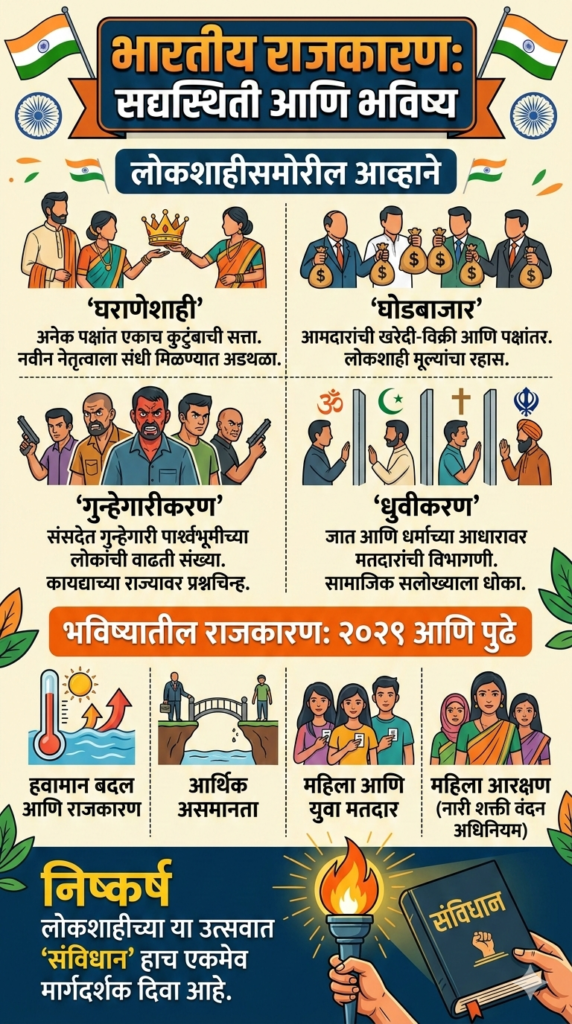
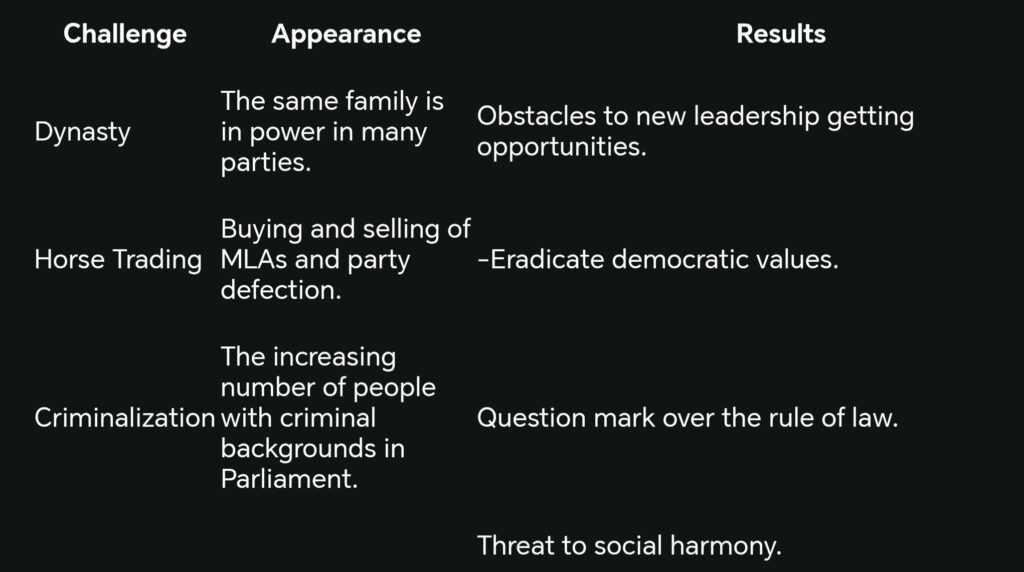
5. Major challenges facing Indian politics
6. Future Politics: 2029 and Beyond
Future Indian politics will depend not only on identity, but also on the following issues:
- Climate change and politics: Issues arising from global warming will become election issues.
- Economic inequality: The growing gap between rich and poor could be a major political explosion.
- Women and Youth Voters: Reservation for women (Nari Shakti Vandana Act) will highlight the crucial role of women voters in the future.
CONCLUSION
Indian politics is never static; it is like a flowing river. The electorate here, though quiet, is very profound. No one can hold the hand of the Indian electorate in dismantling the yoke of power and ushering in change. The ‘Constitution’ is the only guiding light in this festival of democracy.



 By
By